Starhorse & Montenegro Ban Electric and Hybrid Vehicles on Ferries: What Marinduque Travelers Need to Know (2026)
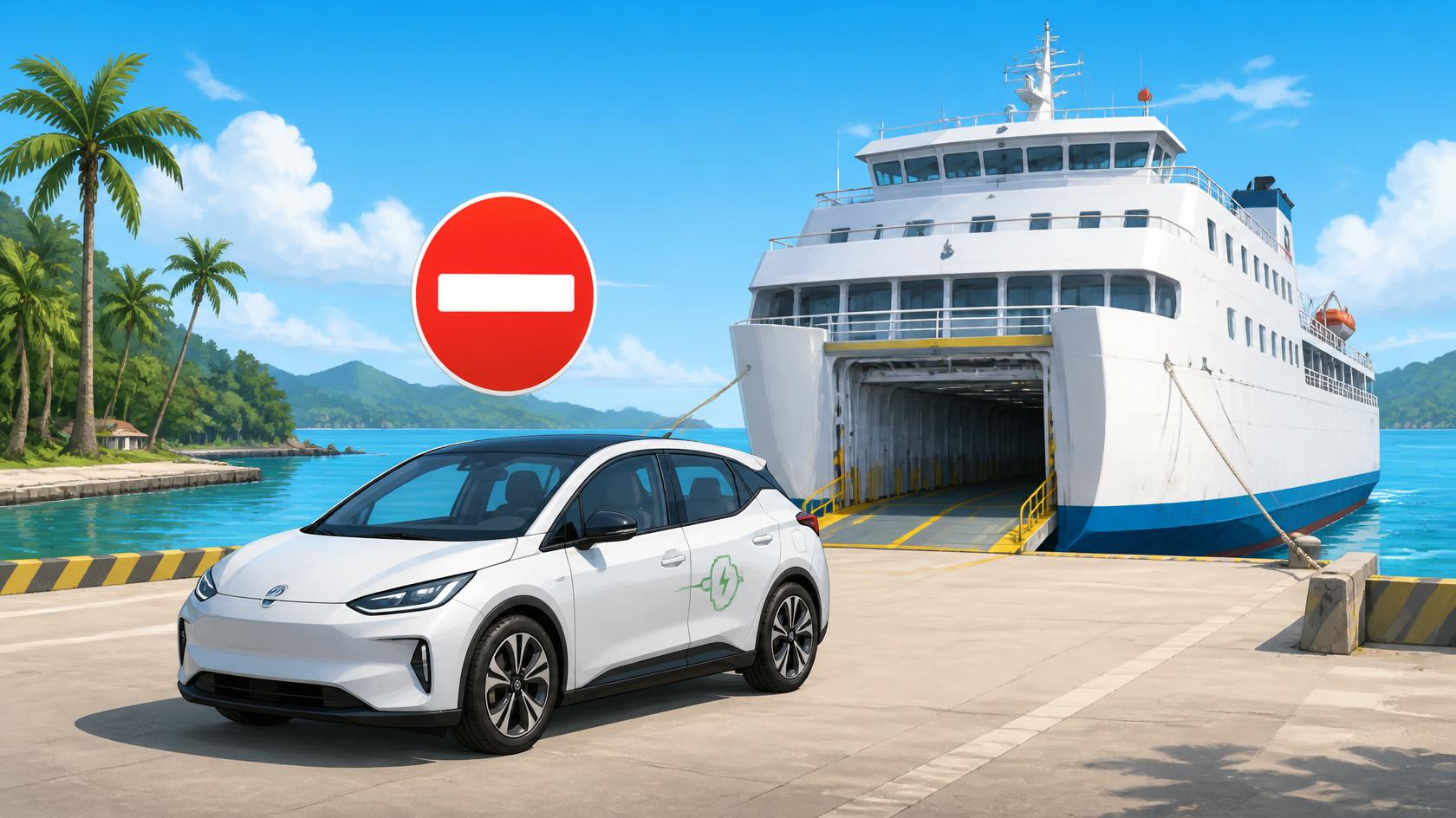
If you were planning to drive your electric or hybrid car onto a ferry to Marinduque, you need to change that plan for now. As of mid-September 2026, both shipping lines that serve the island — Montenegro Shipping Lines and Starhorse Shipping Lines — have stopped carrying electric and hybrid vehicles on their vessels. The ban is effective immediately and has no set end date.
This matters here more than almost anywhere else, because Montenegro and Starhorse are essentially the only two operators running the Lucena–Marinduque RORO crossing. If your vehicle is affected, there is no third line to fall back on. This advisory walks through what's actually banned, why it happened, and the realistic options if it affects your trip.
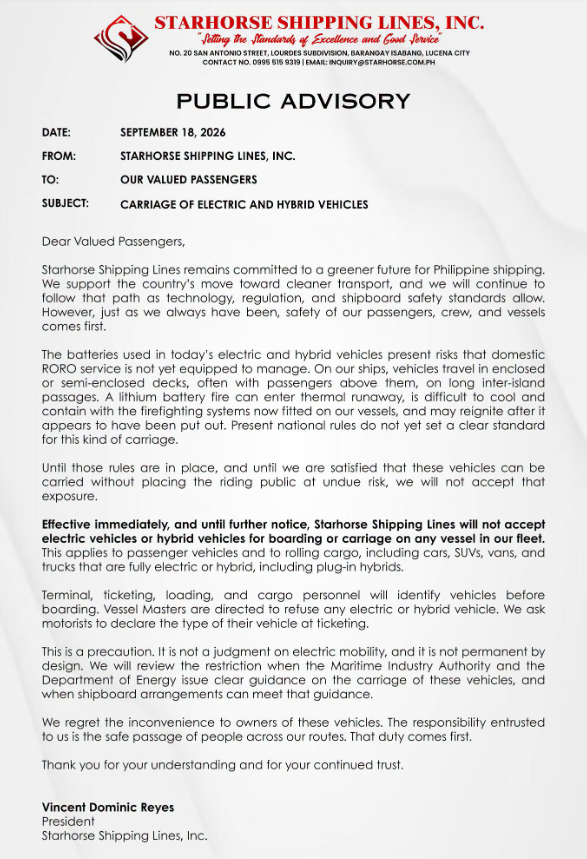
*The public advisory issued by Starhorse Shipping Lines, Inc. on September 18, 2026, signed by President Vincent Dominic Reyes.*
What happened
Within two days of each other, the two lines issued near-identical advisories:
- Montenegro Shipping Lines announced the ban on September 17, 2026, covering fully electric and hybrid electric vehicles on all of its routes.
- Starhorse Shipping Lines followed on September 18, 2026, with President Vincent Dominic Reyes signing a public advisory covering the same vehicle types across the entire fleet.
Both moves came after a fire broke out aboard the MV June Aster en route to Coron, Palawan on September 9, 2026 — a disaster that has pushed vehicle-battery safety at sea to the top of the national agenda. The Department of Energy has since signaled support for the precaution and is working with maritime regulators on formal rules.
Why the lines are doing this
The concern is specific: lithium-ion battery fires. In their advisories, the operators point out that a battery fire can enter *thermal runaway* — a self-feeding reaction that is extremely hard to cool and contain, and that can reignite even after it appears to be out.
That's a serious problem on a RORO ferry in particular. As Starhorse's advisory explains, vehicles travel packed together on enclosed or semi-enclosed decks, often with passengers on the decks above, during long inter-island passages where help is hours away. The firefighting systems fitted to these ships were not designed for that kind of fire. And crucially, there is not yet a clear national standard telling operators how to carry these vehicles safely — so, for now, the lines have chosen not to carry them at all.
It's worth being fair about what this is and isn't. The companies have been explicit that this is a precaution, not a verdict on electric mobility, and that they intend to review it once the Maritime Industry Authority (MARINA) and the Department of Energy issue clear guidance. It is a safety hold, not a permanent policy.
What exactly is banned
The restriction is broad. Based on both advisories, it applies to:
- Fully electric vehicles (EVs) — anything that runs purely on a battery.
- Hybrids, including plug-in hybrids (PHEVs) — vehicles that pair a battery with a combustion engine.
- All vehicle classes — cars, SUVs, vans, and trucks.
- Both passenger vehicles and rolling cargo — it doesn't matter whether you're driving it on personally or shipping it as freight.
Conventional gasoline and diesel vehicles are not affected and can still board as usual.
Enforcement is happening at every stage: terminal, ticketing, loading, and cargo staff are checking vehicles before boarding, and vessel masters have been directed to refuse any electric or hybrid vehicle. Both lines are asking motorists to declare the type of vehicle at ticketing — so don't expect to slip through by not mentioning it, and don't risk driving all the way to the port only to be turned away at the ramp.
If you were bringing an EV or hybrid to Marinduque
Here are the practical ways around it while the ban is in place:
- Leave the EV/hybrid on the mainland and cross as a foot passenger. Marinduque is very manageable without your own car — tricycles, jeepneys, and vans cover the towns, and many resorts can arrange pickups. Our full guide on getting to Marinduque covers the ferry and onward transport options.
- Park at or near Lucena (Dalahican) and continue by ferry. If you drove down from Manila, this keeps your vehicle safe on the mainland side.
- Bring a conventional vehicle instead if having a car on the island is essential for your trip — a gasoline or diesel car, or a rental, will still load normally.
- Rebook or adjust timing if your trip genuinely depends on shipping an EV. Because this is under active review, the rules could change; there's no benefit to gambling on a specific sailing.
Whatever you choose, call the shipping line directly before you travel. Advisories like this can be tightened, clarified, or lifted with little notice, and the person at the ticketing counter will always have the most current version of the rule.
The bigger picture
This isn't just a Marinduque story — it's the leading edge of a national conversation. The June Aster fire has prompted regulators to move on something the industry has flagged for a while: the Philippines has thousands of RORO sailings a year and a fast-growing number of electrified vehicles, but no agreed playbook for carrying their batteries safely across water. Expect MARINA and the DOE to publish guidance in the coming months. When they do, the most likely outcome isn't a permanent ban but a set of conditions — state-of-charge limits, deck placement, monitoring, and fire-suppression requirements — that let these vehicles travel again under clear rules.
For now, though, the situation is simple for anyone heading to Marinduque: if it plugs in, it can't ride the ferry yet. Plan around it, declare your vehicle honestly, and confirm the current rule with your carrier before you go.
*This advisory is based on the official public advisories issued by Montenegro Shipping Lines (September 17, 2026) and Starhorse Shipping Lines, Inc. (September 18, 2026), and on news coverage of the MV June Aster incident and the government response. Details are current as of publication and may change — always verify with the shipping line before traveling.*